Showing posts with label China. Show all posts

Sunday, August 10, 2008

Another Exciting Day at the Olympics

Close to a billion people watched the basketball game between the United States in China, a game that the United States ended up winning easily, 101-70. That makes it one of the most widely-watched basketball games of all time. For comparison, just under 20 million people watched this year's NCAA national championship game in the United States.

The United States broke the world record in the men's 4x100 freestyle relay--in the prelims. However, even though they replaced their three slowest swimmers with three of the world's fastest 100m freestylers, including Michael Phelps, the French team, seeded second in the finals, was the overwhelming favorite to win. And indeed, despite a fast start by the Australians (and Phelps setting the American record in the 100m freestyle to lead things off), the French opened a wide lead over the Americans. Jason Lezak dove in about a body length behind the world record holder, Alain Bernard. With 25 meters to go, it looked as if the French would win it. And then came Lezak: he started inching closer to Bernard, came up right next to him right at the wall, and outtouched him by 8 hundredths of a second for the gold medal. Phelps now is a part of two out of the three American gold medals.

More tomorrow: my last full day in the States!

Sunday, August 3, 2008

A Tour of Beijing

So what is Beijing like? In fact, what is China like? Well, to be quite honest, I don't really know, seeing as how I haven't yet been there. However, China's role in the world is fascinating, and I'd like to take a brief tour of Chinese history and then take a look at what modern China (with particular emphasis on Beijing, obviously) is like.

4000 Years of Chinese History in Two Paragraphs
Chinese civilizations is one of the oldest in history, as Chinese history dates back to roughly 2100 B.C.E. The first recorded dynasty is the Xia Dynasty (don't worry! I'm not going to go through all the Chinese dynasties...), though historians debate whether or not it actually existed. We do know that the Shang dynasty did exist from about 1600 B.C.E. to 1100 B.C.E. in northeastern China. The first Chinese emperor ruled from 221 B.C.E. to 210 B.C.E., named Qin Shi Huang. He was the first to build the Great Wall, and also built the famous terra-cotta warriors (shown).

The Tang Dynasty is perhaps the high point of traditional Chinese culture. When the Mongols took over China, they formed the Yuan dynasty and made Beijing their capital. Later, the Ming dynasty established Beijing as its capital, and laid out the city in its current form. For periods totalling about 350 years between 1425 and 1825, Beijing was the world's largest city. Since then, Beijing has become China's cultural and historical (as well as political) capital and is now China's second largest city. The largest, Shanghai, has become the unofficial economic capital of China.

Modern China
The past 100 years have been very tumultuous for the country of China. At the turn of the 20th century, China was severely weaked by western powers looking to exploit China for its own uses. The Boxer Rebellion and the Opium Wars greatly reduced the power of the once-strong Chinese government and strengthed the power of foreigners. Rebellion and revolution led by the Chinese leaders Sun Yat-Sen and Chiang Kai-Shek kept China in a state of political uncertainty, and the Communists forces in China who had once allied with Sun Yat-Sen were kicked out and sent on what became known as the long march. They reorganized in the 1930's under Mao Zedong.

In 1931, the Japanese invaded China, and weren't kicked out until 1945. There is still bitterness between the two countries over the atrocities committed against the Chinese people by the Japenese. Perhaps the most notable atrocity is "The Rape of Nanking", where 300,000 Chinese in Nanking were killed by the Japenese. After the Second World War, the Communists lead by Mao took over China, and Chiang Kai-Shek's government fled to Taiwan. To this day, that government claims to be the legitimate China (known as the Republic of China, as opposed to the People's Republic of China).

Mao established his government, and supported a total overhall of the status quo. The Great Leap Forward essentially reversed the classes, but had the unfortunate side effect of taking a step backward in agricultural output, causing famine and the death of 30 million Chinese between 1958 and 1961. During this time, China closed itself off to foreign investment (a fact that's certainly hard to believe, in light of everything that is "Made in China" that we see!).

1966 saw the start of the Cultural Revolution, which was nothing short of a dark period in Chinese history. It perhaps was the pinnacle of trying to achieve the egalitarian, communist society, but was so repressive that transportation and education came to a halt. Measures were instituted that took even high ranking government officials such as Deng Xiaoping out as counter-revolutionaries, changed stoplights so that "red" meant "go", and repression of traditional Chinese culture.

With the death of Mao in 1976, Deng Xiaoping took control of the Chinese government by 1980, and began opening up China to the rest of the world. The Chinese economy began to grow as foreign investment was brought back to China, and the quality of life in China began to drastically improve.

China Today
The opening up of China is perhaps the beginning of the road to the 2008 Beijing Olympics. The Chinese government began in 1978 with a speech by Deng Xiaoping, who urged the government not to guide the country by ideology, but by facts and economic development. Since then, the Chinese economy has grown at an average of 9% a year--that means that every 8 years, it doubles! 400 million Chinese have moved out of poverty. That's a monumental change from the time of Mao.

Today, the 20 fastest growing cities in the world are all in China as people move to the large cities in Eastern China. For example, Chongqing expands by 300,000 people every year. This transformation is only accelerated by China's preparation for the Olympics. The world's largest airport terminal is in Beijing (it opened this past spring, and the area of Terminal 3 in Beijing Capital Airport is larger than that of the Pentagon). Beijing also has 6 new subway lines, a 43-kilometer light rail system, and a 12 square kilometer Olympic Park. Every international businessman has their own statistic regarding China and their brand new impact on the world.

China, a country of 1.3 billion people, has emerged as one of the biggest economies in the world, and is asserting itself as such. The Beijing Olympics are a testament to everything that it's done in the past 30 years, and everything it hopes to accomplish in the future. It is, in that light, a small wonder that China has done so much to make these Games absolutely perfect.

The measures it has taken are drastic. It has created the Beijing Weather Modification Office, armed with equipment and science to prevent it from raining during the Games--and especially during the Opening Ceremonies. It has clamped down on giving out visas, in hopes of preventing dissidents from protesting sensitive issues like Tibet and Taiwan. It has taken 60% of the cars off the street and shut down hundreds of Beijing factories in order to halt pollution, something the International Olympic Committee has been worried about.

The Chinese Government
The Chinese government controls the country in a one-party system of communism. It is now one of five communist countries in the world (along with Laos, Vietnam, Cuba, and North Korea. It is ironic that we had armed conflicts with three out of the five remaining communist countries specifically to stop the spread of communism). Political dissidents are silenced, and China has been repeatedly accused of human rights violations, especially with regards to Tibet. Officially, the Chinese government is atheistic, but it recognizes certain religions organizations, while trying to suppress unrecognized religions. Clearly, the Chinese views the rights of its citizens slightly different than, say the United States, but before we reject their views, it is interesting to note that 86% of the Chinese say their country is moving in the right direction. Try finding 86% of Americans to agree on anything!
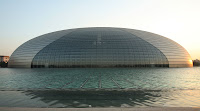
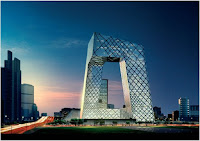
It certainly will be an interesting experience to see what Beijing has in store for us: elaborate gardens, an enormous airport terminal, brand new buildings such as the Bird's Nest, the Water Cube, the CCTV tower (pictured above), and the National Theater (also pictured). Who knows what the Chinese have in store for us? We have a little over a week to find out!!

Monday, April 7, 2008

The Olympic Torch and Tibetan protestors

It seems as though every Olympic games has its troubles. The '96 games in Atlanta had traffic problems, allegations of bribery, and a terrorist incident that killed 11 people1. The '00 games in Sydney seemed "mired in troubles" less than five months out2. The '04 games barely finished their venues, and was a financial disaster for Athens3. So it should come as little surprise that Beijing is having troubles of its own in the months leading up to its opening ceremonies.

As you may well know, the Olympic torch relay has had considerable controversy surrounding it. The torch (pictured right), as I noted earlier, is going all over the world, and is currently going between some of the major European capitals, including London and Paris. Each of its stops has sparked protest from groups opposed to China's takeover of Tibet in 1959. In Paris, the torch was extinguished during the turmoil of protesters4.

The protests have not been limited to cities where the torch is. In San Francisco on April 7, climbers got onto the Golden Gate Bridge and put up signs with slogans along the lines of, "Free Tibet 08". Senator and presidential candidate Hillary Clinton announced that she wanted President Bush to impose a "partial boycott" of the Olympics by not participating in the Opening Ceremony because of China's failure to deal with both Tibet and the Sudanese situation in Darfur5.

Chinese embassies from places like Budapest, Vilnius, Rome, and Reykjavik have been bombarded with protesters, symbolizing international pressure on China to do something regarding Tibet. In The Hague, protesters stormed the consulate, replacing the Chinese flag with a Tibetan flag (pictured below: this flag is illegal in China)6.

The problems the Chinese have had with their torch relay from Greece to the U.K. to France may cause significant changes in the route. For example, the section of the route scheduled to go to Tibet may be canceled or altered7.

For China, this is an international PR disaster. The torch relay was, in a sense, China's big "homecoming," with its magnificence. The Chinese have been planning everything down to a tee to make sure that everything ran flawlessly. 123 days before the opening ceremonies, the torch relay has been in every sense a nightmare. Mobs, protesters, Tibetan flags: the magnificence of China's torch relay is, in a poetic sense, going up in flames.

The only people in the world unaware of the disaster that is slowing unfolding toward Beijing are, unsurprisingly, the Chinese themselves. Extensive censorship of news coming into the country (and news coming out of Tibet) has limited the government's image in its own people8.

Nonetheless, China must be worried right now about what's going to happen. After all, if protesters are doing this to torchbearers in their own countries, what could happen in Beijing. With on the order of two million people headed to Beijing in August, how many of them could be protesters, and of those, who might become violent, resorting to terrorism? Big name events (especially where the Chinese may be favored and the opening and closing ceremonies) could be especially lucrative terrorist attacks. The question now is what China will plan on doing to protect its tourists (and thus, its image--the all important factor of the 2008 games)? It remains to be seen how China will work out its Olympic troubles.

References
1. Wikipedia: 1996 Summer Olympics
2. IOC plays down troubles as Sydney Olympics approach
3. Wikipedia: 2004 Summer Olympics
4. Olympic Torch Run in Paris Halted as Protests Spread
5. Clinton calls for partial boycott; torch protesters scale Golden Gate Bridge
6. Wikipedia: 2008 Tibetan Unrest
7. Olympic Officials May Reconsider Torch Relay
8. Chinese Media in Spin of Indignation

Thursday, March 27, 2008

What is going on right now in Beijing?

The Beijing Olympics has proven to be a very polarizing event, with some of the most elaborate and extravagant preparations in Olympic history being completed on one hand, while protesters line streets against the Chinese government on the other hand. Aspects of both have made front page news for months now. Thus, I will devote this blog to the "positive" aspect of the Games first, and then the "negative" aspect.

Three days ago, on March 24, the longest torch relay in history began when the torch was ignited in Athens, Greece. On the 30th, it will leave Greece and head to Beijing, beginning its marathon journey of 85,100 miles on continents. One of the highlights of the trip will be an attempt to carry it to the top of Mount Everest, an event that the Chinese government will assuredly claim to be a success1.

The Chinese will have poured close to $40 billion into making the 2008 Olympic Games a showcase for the world. The facilities are incredibly expensive, and at the same time, spectacular in their own right2. The two facilities that people in the United States may be most acquainted with (and ones which I will be in) are the Beijing National Aquatic Center (i.e., the Water Cube or [H2O]3) and the Beijing National Stadium (i.e., the Bird's Nest), both of which are pictured, with the Water Cube in the foreground.

In addition, Beijing is trying to update their outdated mass transit system before the games arrive. The subway system will be newly renovated and the cab drivers will (supposedly) all know some English3 4. The Beijing airport, already the 9th largest airport in the world in terms of passenger traffic, is building another terminal, set to open this month. As a side note construction for a new "super-airport" is set to begin in 2010, replacing Beijing Capital International Airport. It will be capable of 70-100 million passengers per year. For comparison purposes, Atlanta, the world's busiest airport, has almost 90 million passengers per year5.

As I address the first of the negatives, I will start by saying that China is doing everything in their power to address this. Beijing is one of the most polluted cities in the world, as you can see by the picture of the smog in Tiananmen Square. China has been enforcing government regulations in order to reduce the output of pollution, and may institute similar practices during the actual games. The Chinese have even gone so far as to perform atmospheric tests by releasing chemicals to see if they can control the weather so it doesn't rain on their Olympic party6.

In going to China, one of our concerns is not so much the pollution for us (we're not going to be there that long), but the fact that some of the long-distance events such as triathlon may be postponed, which wouldn't work out for our rather tight schedule7.

Another negative is the current situation regarding Tibet (and Taiwan). I won't go into any details, simply because I don't know many of the details, but suffice it to say that China has some strained relationships with some of its neighbors. The region of Tibet is part of China, but the Chinese government has practiced a sort of cultural genocide against the Tibetan nation. As a result, there have been many protests, some of which happen during the torch relay. That is bad PR for the Chinese to the rest of the world, though Chinese censorship makes it so that the Chinese people never know about it. On the other hand, China believes that it owns the island of Taiwan, which has declared sovereignty, but it is only formally recognized by about 30 countries (not including the United States)8.

China has other issues, many dealing with human rights and the interminable question of how well prepared Beijing will be for the Olympics. The present day political clime asks the question of how well protected the Games will be from a terrorist attack. Analysts expect two million visitors from around the world to be present for China's exposition to the world9. How will that hold up?

References:
1. Wikipedia: 2008 Olympic Torch Relay
2. Olympic Games the Chinese Way
3. Wikipedia: 2008 Summer Olympics
4. 90,000 Beijing Taxi Drivers to Learn English
5. Wikipedia: Beijing Capital International Airport
6. Beijing to Shoot Down Olympic Rain
7. Endurance Athletes Worry About Pollution in Beijing
8. CIA World Factbook: Taiwan
9. China, Air Travel, and the 2008 Beijing Olympics